

THE STORY
Seattle-based Hubble Network announced September 23 that it is opening satellite access beyond pilot customers, offering supported devices a route to space through Bluetooth Low Energy radios already inside them. Existing customers of its terrestrial network can add satellite access through firmware updates, while new customers can register for development kits. The capability shift is the attempt to make satellite connectivity an extension of an existing device integration, without adding a separate satellite modem. These availability and compatibility statements come from Hubble’s announcement; they do not establish that every Bluetooth product can connect automatically.
The hardware proposition is unusually compelling for something so small. Bluetooth Low Energy is the radio technology Hubble says supported integrations can use for its service. If a customer’s existing device qualifies, the firmware path could let that customer add satellite access without replacing its radio hardware. That is the specific engineering promise worth watching. It does not tell us how frequently a device can deliver a message, how much data it can send or how consistently delivery succeeds. The supplied evidence contains no independent delivery-success measurements, latency figures, throughput results or complete compatibility list. General availability describes access to the service, not a measured guarantee of performance in every location.
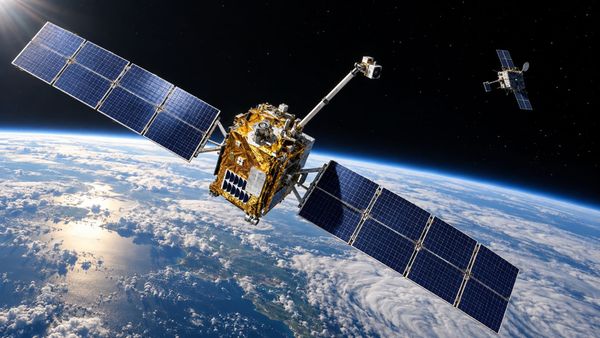
Hubble reports six operating satellites and plans to expand to 60 by 2030. Continuous global coverage remains an expansion objective. The company also reports more than 500,000 active devices on its terrestrial network and more than 100 million gateways across 170 countries. Those figures describe its ground-network footprint; they are not counts of devices already communicating through satellites. Samsara is identified as a satellite pilot customer, and Muon Space is contracted to supply larger next-generation satellites using MuSat XL. Together, those details show the two sides of the expansion: bringing existing integrations into the satellite service and building additional orbital infrastructure.
The announcement accompanies a $200 million Series C at a $1.6 billion valuation, funding figures also reported by Bloomberg. Bloomberg describes a combined satellite and ground network for monitoring Bluetooth-equipped packages, vehicles and pharmaceuticals. The prospective capability is a tracking system whose customers can draw on both network layers through supported devices. If Hubble demonstrates reliable operation and expands coverage, it could make orbital connectivity available to applications that would otherwise need a different hardware integration. The immediate milestone is broader service access; the larger constellation and its promised coverage are still ahead.
THE DOUGH
Smith Point Capital led the Series C, and Hubble says its total funding has reached $300 million. The planned constellation expansion creates a potential spending path into satellite manufacturing and network infrastructure, with Muon Space already identified as a contracted supplier. For tracking-device and logistics businesses, the speculative benefit is adding coverage through supported existing hardware; the supplied evidence provides no satellite customer revenue or service economics to quantify that opportunity.
We are not financial analysts or investment advisors. Nothing in this newsletter constitutes investment advice. All economic analysis is speculative and for informational purposes only. Do your own research.
THE POSSIBILITIES
A plausible source of competitive advantage is Hubble’s existing device-integration base: customers already using its terrestrial network may have a shorter path to trying satellite access. If those integrations translate into reliable orbital connections, software compatibility could become an important distribution channel for a space service.
THE HURDLES
Six reported operating satellites do not establish continuous worldwide coverage, and the 60-satellite fleet remains a plan. Independent delivery results, supported-device details and message timing are needed to determine which tracking applications the service can reliably support.
WHAT TO WATCH
- Independent message-delivery and latency measurements across different locations.
- A clear compatibility list and documented firmware requirements.
- Evidence that pilot users become recurring satellite-service customers.
- Muon Space satellite deliveries and growth beyond the reported six-satellite fleet.
- Separate reporting of terrestrial activity and satellite-connected usage.
Void Economy is researched, written, and illustrated with AI, reviewed and edited by a real, live, flesh-n-blood human.