
THE STORY
Outpost has introduced Space Factories, a proposed orbital manufacturing service that would handle spacecraft infrastructure and Earth return while customers supply their production processes. Its September 24 release describes a modular architecture intended to make manufacturing in space repeatable. Outpost plans to be its own first user: Payload reports a StarFiber optical-fiber manufacturing mission no earlier than 2028. That mission is intended to validate production before the platform opens to other materials and customers. This is a service announcement and demonstration plan, with no completed production-and-return cycle established by the supplied evidence.
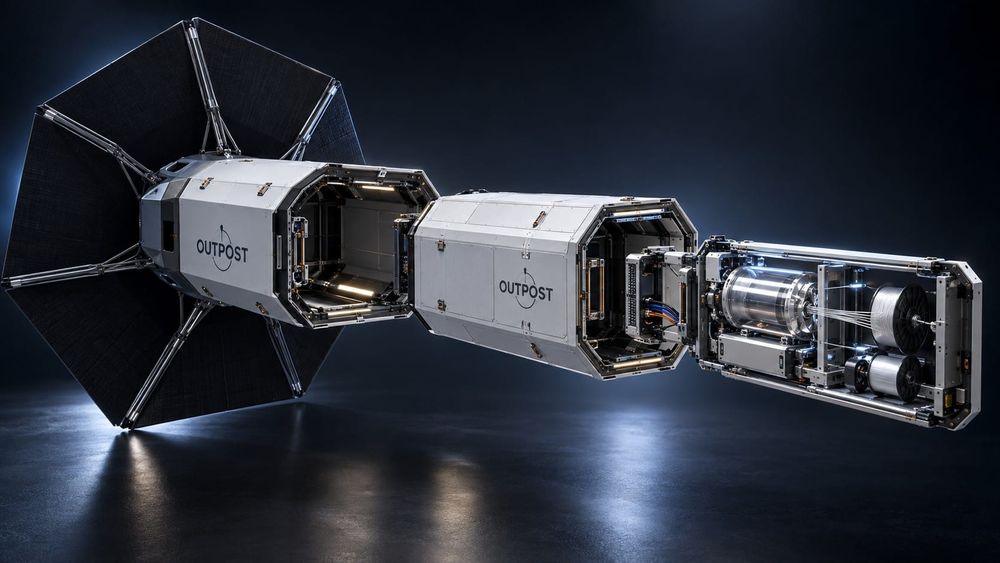
The architecture divides responsibilities into three layers. CarryAll would provide transport, power, communications and return. A separable factory container would manage production, pressure, thermal conditions, data and safety interfaces. Inside that container, a customized manufacturing module would perform the customer’s particular process. The distinction matters: Outpost is proposing a common transport and operating environment around equipment that can differ from product to product. After recovery, equipment would be inspected, refurbished and flown again. Standardization and reuse are the company’s proposed mechanisms for reducing repeated engineering; actual savings remain to be demonstrated.
StarFiber gives that infrastructure a specific first job. It is Outpost’s metal-fluoride optical-fiber product, which the company says could benefit from fewer manufacturing defects in microgravity and achieve lower signal loss than conventional silica fiber. The release provides no measured attenuation—the amount of signal lost along a fiber—or production yield. Those omissions separate a promising materials claim from a demonstrated product advantage. Payload connects the effort to CEO Jason Dunn’s earlier optical-fiber work at Made In Space and identifies timely recovery of finished products as a motivation for Outpost’s return-vehicle approach. Production quality and getting the product home are both part of the proposition.
The envisioned scale extends from shoebox-sized modules to a full CarryAll, according to commercial executive Ryan Reel. Payload reports planned production volumes of 16 cubic meters for Block 2 and up to 33 cubic meters for Block 3; these are proposed variants. Reel also anticipates pharmaceutical and life-sciences demand, arguing that uncrewed factories could accommodate high-energy or off-gassing processes constrained aboard crewed stations. If demonstrated, the new capability would be a reusable production-and-return service that lets manufacturers develop a process within defined interfaces. The decisive test is whether that architecture can repeatedly bring home valuable material at usable quality and volume.
THE DOUGH
Outpost’s proposed business would sell access to manufacturing and return infrastructure, potentially directing spending toward process equipment, factory integration, refurbishment and recovery. StarFiber could give the company a product with which to demonstrate the service before relying on external manufacturers. Pharmaceuticals and life sciences are management’s expected early markets, rather than disclosed contracted demand. Pricing, throughput, independent fiber performance and profitability remain unestablished in the supplied evidence.
We are not financial analysts or investment advisors. Nothing in this newsletter constitutes investment advice. All economic analysis is speculative and for informational purposes only. Do your own research.
THE POSSIBILITIES
If the common interfaces prove stable, a manufacturer might be able to revise its production module between flights while retaining much of the surrounding infrastructure. That could make recovery valuable for process development as well as product delivery: returned equipment could inform the next manufacturing run.
THE HURDLES
The initial mission must establish that StarFiber can be manufactured and returned with a measurable product advantage. Reuse also needs evidence across successive flights; inspectability and refurbishment plans alone cannot establish economical repeat operations.
WHAT TO WATCH
- A firmer schedule and defined success criteria for the mission planned no earlier than 2028.
- Independent StarFiber attenuation measurements and usable production yield.
- A completed manufacturing-and-return cycle, followed by equipment reflight.
- External customer commitments and published service interfaces or pricing.
Void Economy is researched, written, and illustrated with AI, reviewed and edited by a real, live, flesh-n-blood human.